How Security Staffing Ratios Are Calculated for Large Events
August 26, 2026
QUICK ANSWER: There is no single guard-to-guest ratio that fits every event. Industry benchmarks generally range from one officer per 25 to 50 guests for smaller, alcohol-served gatherings up to one officer per 100 to 250 guests for large, low-risk, seated events. The starting ratio then shifts based on entrance count, alcohol service, venue layout, VIP zones, and crowd behavior. A 500-guest wedding with one bar and one door needs a different plan than a 500-guest festival stage with four gates and a beer garden. Event Security Specialists builds staffing around a venue walkthrough rather than a headcount alone, then adjusts posts by risk factor, not just body count.
Your guest count tells you how many people are showing up. It doesn't tell you how many doors they'll use, whether there's a bar running all night, or how tight the crowd gets once the music starts. Staff an event off the headcount alone and you end up in one of two spots: officers standing around an empty hallway, or one gate with a line stretching into the parking lot and nobody free to work it. The number that actually matters comes from several inputs stacked together, and attendance is just the first one.
Where the Baseline Ratio Comes From
Most security firms start with a range, not a fixed number. Smaller gatherings with alcohol service — weddings, private parties, fundraisers under a few hundred guests — commonly run one officer per 25 to 50 attendees. Larger, lower-risk events with seated crowds and controlled access can run closer to one per 150 to 250. Concerts, festivals, and standing-room events with heavier movement usually land somewhere in between, around one officer per 75 to 150.
Those ranges are a starting point. Not the plan itself. Two events with identical attendance can need very different staffing once you factor in venue layout, access points, and what's actually happening on-site — a fenced venue with a single controlled entrance staffs completely differently than an open, multi-block footprint at the same headcount. The ratio gives you a rough order of magnitude. The walkthrough is what turns that range into an actual post-by-post plan.
A guard-per-attendee formula assumes every guest interacts with security the same way. They don't. Most of the workload piles up at entrances, bars, and exits — not evenly across the room. Two events with the same guest count but a different number of doors will need a different officer count before any other factor even enters the picture.
Attendance and Crowd Density
Total guest count sets the floor. Peak density is what actually matters more than the number on the guest list. A few hundred people packed near a single stage need closer monitoring than a bigger crowd spread across an open lawn. Officers watch for compression points — spots where crowd density climbs faster than the space around it, usually near barricades, stage fronts, and bottlenecked walkways. Tell your security provider whether attendees are arriving all at once in a doors-open rush or trickling in over several hours. A compressed arrival window packs the same headcount into a shorter, higher-pressure stretch of time.
Venue Layout and Entrance Count
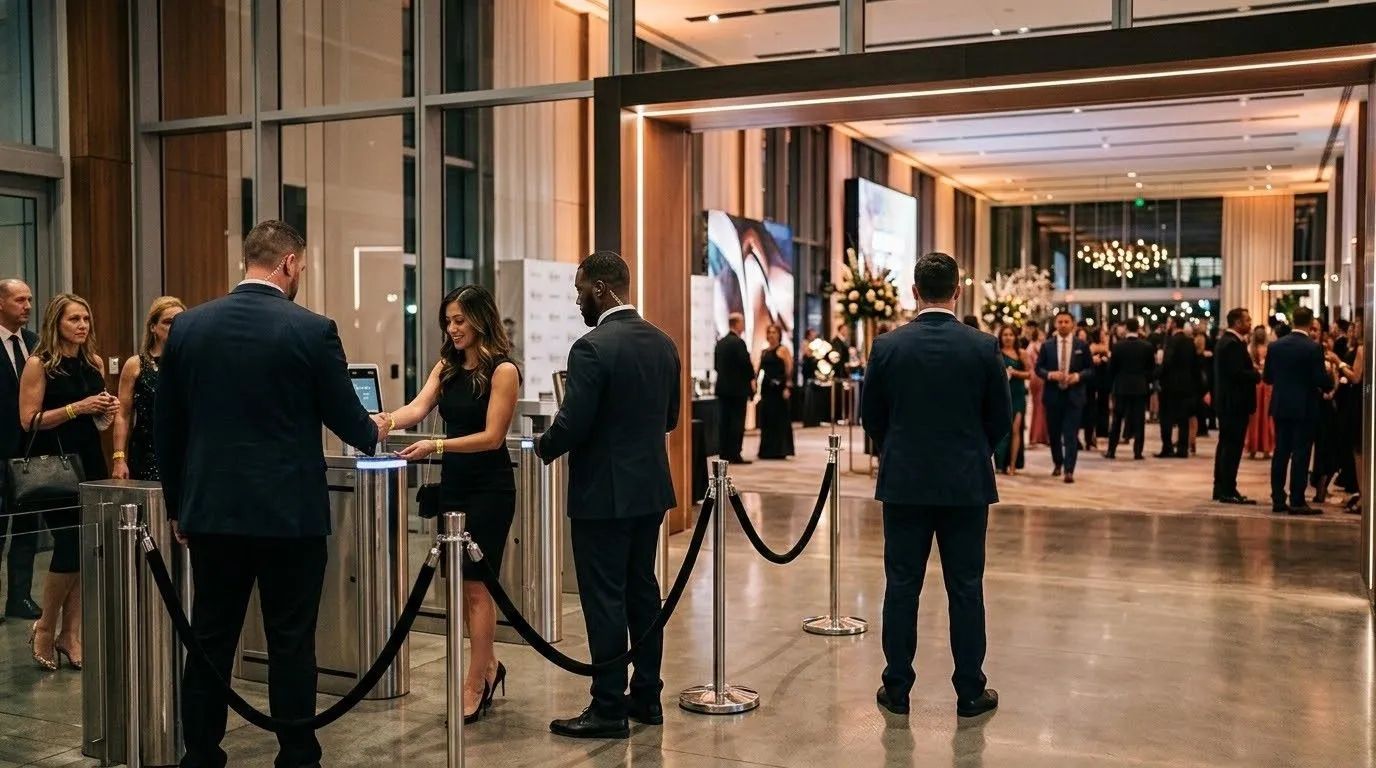
Every entrance is its own line item on the staffing plan. A single controlled door needs a fraction of the coverage that the same guest count needs spread across four gates, and each of those gates needs its own screening team, credential check, and queue management. Officers also cover parking areas, restricted zones, vendor and load-in areas, and emergency access routes — none of which show up in the crowd headcount at all. That's the reason a plan starts with a site walkthrough instead of a floor plan review. Sightlines, blind corners, and choke points show up in person in a way no document on paper captures.
Alcohol Service and Post-Specific Coverage
Alcohol moves the math more than almost anything else. Bars raise the odds of disputes, medical calls, and impaired guests trying to drive home, and that pushes staffing toward the denser end of the ratio range while adding dedicated posts at bar areas, exits, and parking zones. A single bar with light pours needs less bar-adjacent coverage than a program running multiple stations all night. Officers working alcohol areas support venue staff with identification checks, keep an eye on guests who've had too much, and manage departures before a situation escalates, not after.
TIP: Give your security provider the alcohol service plan — number of bars, service hours, hosted or cash — as early as the guest count. It changes post placement more than almost any other variable.
VIP Zones, Cash Handling, and Higher-Risk Posts
Backstage areas, VIP sections, and cash points like the box office, merchandise table, or bar till get their own staffing line instead of getting folded into the general ratio. These posts are fixed. One officer holds a specific access point for the whole event rather than roaming, because the job is controlling who crosses that line, not patrolling open space. Armed coverage gets considered specifically for posts tied to cash handling, valuable inventory, or documented threat history, and those officers carry current BSIS exposed firearm permits and requalify on a set schedule.
Licensing Mix: Armed and Unarmed Coverage
Not every post calls for the same credential. Entry screening, wristband checks, and general crowd monitoring are typically staffed with unarmed officers licensed through the California Bureau of Security and Investigative Services. Posts tied to cash handling, high-value assets, or heightened threat indicators may call for armed coverage instead. Get this mix right during planning, rather than defaulting every post to one license type, and the staffing plan matches the actual risk at each location instead of running uniformly heavy or uniformly light.
Building the Post Assignment Map
Once the ratio, layout, and risk factors are set, the plan becomes a post assignment map. Named positions, shift times, radio channels, and a chain of command tying each post back to a supervisor. Entrances get dedicated screening teams. Bars and exits get fixed posts. Whatever officers are left get distributed as roaming coverage across the floor, parking, and perimeter, placed wherever the walkthrough turned up the heaviest foot traffic and the worst sightlines. This document is what turns a number into something officers, venue staff, and event organizers can actually follow on the night of the event.
WARNING: A staffing plan built only from a ratio, without a venue walkthrough, tends to under-staff entrances and over-staff open floor space. Confirm your provider has walked the actual site, not just reviewed a floor plan, before the officer count is finalized.
Coordinating With Venue and Promoter Teams
The post map doesn't run on its own. Radio contact ties officers to venue management, medical teams, and event promoters, so a developing problem — a compression point building near the stage, a line backing up at a gate — gets flagged and handled before it outgrows what the posted officers can manage alone. Coordination covers evacuation roles too. Officers assigned to specific exits know their route ahead of time, so a medical call, weather delay, or alarm doesn't turn into improvised crowd movement in the moment.
Frequently Asked Questions
Is there a standard security guard-to-guest ratio for events?
No single standard applies. Ratios may range from one officer per 25–50 guests for smaller events to one per 150–250 guests for larger, lower-risk events, depending on specific conditions.
Does venue size change the staffing ratio even at the same guest count?
Yes. Compact venues with fewer entrances may require fewer officers, while larger venues with multiple entrances, separate zones, parking areas, and restricted spaces typically require additional security coverage throughout events.
How much does alcohol service affect the officer count?
Alcohol service can significantly increase staffing needs because it raises risks involving disputes, medical situations, and impaired departures, often requiring dedicated officers around bars, exits, parking areas, and gathering spaces.
Do VIP areas need separate security coverage from the general crowd?
Usually, yes. VIP areas, backstage sections, and restricted access points often require dedicated officers who manage credentials and control entry separately from security personnel monitoring general crowd activity throughout venues.
When should the officer count be finalized — before or after the venue walkthrough?
Officer counts should generally be finalized after the venue walkthrough. An on-site assessment reveals entrances, blind spots, crowd routes, restricted areas, and other conditions that directly influence security staffing requirements overall.
Are unarmed officers sufficient for most event posts?
Yes. Unarmed officers generally handle entry screening, credential checks, and crowd monitoring. Armed officers may be considered for cash handling, valuable assets, documented threats, or other identified higher-risk security situations.
Building the Right Security Plan for Every Event
Effective event security starts with attendance, but the final officer count depends on how people actually move through the venue. Entrances, alcohol service, crowd density, VIP areas, parking zones, and restricted spaces all influence where officers need to be positioned. A thoughtful staffing plan accounts for these conditions before assignments are finalized, helping organizers maintain orderly entrances, clear pathways, controlled access points, and consistent coverage throughout the event without relying on a generic guard-to-guest formula alone for planning purposes.
With 25+ years of industry experience, Event Security Specialists
understands how Sacramento, CA events can vary from intimate private gatherings to large concerts, festivals, and public functions. Careful walkthroughs and post-by-post planning allow security coverage to reflect the venue, schedule, crowd activity, and specific risks involved. When staffing decisions are based on real site conditions rather than attendance alone, organizers gain a practical security structure that supports smoother operations, stronger coordination, and a safer, more organized experience from arrival through departure.